








Outsourcing memory

Have you ever thought about how little we remember for ourselves anymore? Scholars talk about how cultures move from being oral cultures, in which the stories are passed down by word of mouth and held in the collective memory of the tribe, to written cultures, in which they are preserved in books, and now to what they’re calling “secondary orality,” as we move away from the written word; but it isn’t a move back toward a primary reliance on human memory. Instead, we’re simply replacing written media with visual/aural ones—the reliance on technology continues, as we outsource our memories to books, pictures, video, computers, PDAs, and the like. Indeed, a PDA is basically a handheld prosthetic memory; if you have one, and you remember to use it and keep it with you, you don’t have to remember what you need to do, where and when you need to do it, who you’re going to do it with, or what their phone number is—just press the right button, or buttons, and the box remembers it all for you and tells you what you need to remember when you need to remember it.

The advantage to storing so much of our memory outside ourselves, I think, is that less of our brain is needed for that task, which means there’s more of it that we can use for other purposes, like inventing new things. I don’t know if anyone’s ever looked into this, but that might explain the accelerating pace of technological progress. After all, each new invention that frees up a little more of our brainpower from the work of memory gives us that much more brainpower to come up with new ideas and new ways of doing things—and gives us ways to record and store those increasingly more complex ideas, allowing us to interact with them more easily and quickly; and as these inventions enable us, more quickly, efficiently, and completely, to share those with others, that multiplies the effect. So in that sense, maybe the fact that we don’t remember as much ourselves, that we rely on other means to do it for us, is one cause of all the material benefits science and technology have given us.

There are downsides, too, though. Not only can all those things break, or get lost, or simply not be where we need them when we need them, there’s also the fact that our memories tend to be less vivid and immediate, more distant from us—less real, we might even say. Rather than being part of our present reality, they come to us as shadows of another time. To be sure, this would be the fate of most of our memories regardless, and there will always be things we would rather let slide into oblivion—but what about the key moments in our lives, the ones that make us who we are? Consider that to a large part, memory is identity. The more distant our memories become from us—a problem worsened by the speed and busyness of life in the Western world, which leaves us little time to stop and reflect, and remember—the more distant we become from ourselves, and thus from others, and from God.

(Update: I first wrote this, for other purposes, back in the summer of 2006, so I may actually have gotten to this idea first, as I [probably naively] thought I had; but in the interim, David Brooks has gotten here too, from a quite different angle—neither fact of which is surprising.)

Larry Norman, RIP

Christian music legend Larry Norman died last Sunday morning at the age of 60. In one sense it wasn’t surprising, as his health had been terrible for a long time; in another, though, it was a shock. This man rocked the world for Jesus Christ, casting a vision that all too few Christian musicians have had the wisdom (or the nerve) to follow; and if he was a difficult saint, that was true of many of those whose vision rose above the mediocrity of CCM (most notably Keith Green, Mark Heard, and Rich Mullins)—because they were the people who simply could not be comfortably at home in this world.

Larry Norman helped a lot of people see Jesus who might not have otherwise, and he helped many more see the vast world of possibility in Christ beyond the conventional wisdom. I include myself in that category; his great albums were fifteen years old and more when I first heard them, and they still blew me away. Indeed, they still do, another fifteen years on. Michael Spencer is right: “Almost thirty years later, the word masterpiece is not wasted on the entire endeavor.” The church is richer because of Larry Norman, and would be richer yet if more of its artists had emulated his unflinching integrity and high sense of mission. I’m glad for him that he’s been released to the peace for which he longed.

John McCain, supply-side conservative?

Maybe so—he’s letting Phil Gramm develop his economic policy. (Actually, it sounds like Sen. Gramm has effectively become not just his chief economic advisor, but his chief political advisor.) Apparently, though I hadn’t known it, the two have been close friends for a long time, and Sen. Gramm considers Sen. McCain a strong ally as well; certainly he endorsed Sen. McCain in ringing terms. It sounds, further, like a McCain administration might well resurrect the old conservative dream of Phil Gramm as Treasury Secretary; so far, Sen. Gramm is saying he wouldn’t want to do that, but I suspect that one way or another, he’d end up the primary influence on economic policy—Sen. McCain admits it isn’t his strong suit, and it’s clear that he’s identified Sen. Gramm as the person whose advice he should follow in that area. (Given Sen. McCain’s strong record of opposition to special interests and pork-barrel spending, the real allegiance between these two men should be clear; this is no marriage of convenience.) If that doesn’t allay the concerns of fiscal conservatives, I’m not sure what could. It certainly allays mine.

C. S. Lewis and the untameable God

This month’s mailing for the InterVarsity Press Book Club arrived with two familiar names on the cover: the featured Main Selection this month (there’s another one as well) is Is Your Lord Large Enough?: How C. S. Lewis Expands Our View of God, by Dr. Peter Schakel. Lewis’ name, of course, is familiar to many; Dr. Schakel’s name is less so, but in the world of C. S. Lewis scholarship, he’s an important contributor. Walter Hooper, in a blurb on this book, calls him “the wisest and humblest of C. S. Lewis’s commentators,” and I think that’s a fair assessment. Of course, I’m biased in this matter. I majored in English at Hope College, where Dr. Schakel is Cook Professor of English (and chaired the department during my time there), and in addition had him as my Sunday school teacher for a while; in that time, I came to have a very high opinion of him, both as a professor and as a godly man, and to hold him in great affection and esteem. That said, I think my opinion is accurate; I’ve valued other things he’s written (a list which includes Imagination and the Arts in C. S. Lewis: Journeying to Narnia and Other Worlds, Reason and Imagination in C. S. Lewis: A Study of Till We Have Faces, The Way into Narnia: A Reader’s Guide, and, among other textbooks, Approaching Poetry: Perspectives and Responses, co-written with Jack Ridl), and I look forward to reading this one. It’s certainly a worthwhile topic; most of us have the tendency to let our view of God shrink, and there are few people better than C. S. Lewis to help us correct that tendency.

Bill Simmons for Sportsman of the Year

I don’t tend to talk much about sports here—I do that other places (some of them listed to the left) where the conversation is already going on—but as a long-time fan of the Seattle SuperSonics (one of my earliest memories is of listening to part of the 1979 NBA Finals with my dad) I had to say this: Thank you, Bill Simmons.

In six years of writing for ESPN.com, this is the longest piece I’ve ever sent to my editors — nearly 15,000 words of anguished e-mails from Sonics fans around the country. I spent the past 24 hours sifting through them and whittling them down the best I could. Don’t print this baby out. Read it, skim through it, do whatever you need to do. But definitely check it out.

Here’s why the Seattle situation should matter to everyone who cares about sports: After being part of the city for 41 years, the Sonics are being stolen away for dubious reasons while every NBA owner and executive allows it to happen, including David Stern, the guy who’s supposed to be policing this stuff. I think it’s reprehensible to watch someone hijack a franchise away from the people who cared about the team and loved it and nurtured it through the years. It belittles not just the good people of Seattle, but everyone who loves sports and believes it provides a unique and valuable connection for a city, a community, family members and friends.

Thank you. Thank you for the opportunity to let an entire fanbase speak. In the end, thanks to the efforts of Save Our Sonics (the brainchild of Brian Robinson, Steven Pyeatt, and the other folks behind SonicsCentral—Sonics fans everywhere owe those guys a huge debt of gratitude), with special appreciation for the work of Seattle city attorney Tom Carr, I continue to believe that Seattle will not lose its team; still, the ongoing threats and arrogance and insults and mendacity we’ve had to suffer from Clay Bennett and his ownership group, and the possibility that despite everyone’s best efforts and all the emotional and financial support invested in this team over the past four decades, these robber barons might actually be allowed to steal our team, have taken a real toll. Thank you, Bill, for letting us speak.Update: Here’s his follow-up. I don’t agree with every idea he has, but I love the walk-on idea; and again, thanks to Bill Simmons for giving us a voice and a platform.

William F. Buckley, RIP

The father of modern conservatism died this morning of emphysema at the age of 82. The founder of National Review, the host of “Firing Line,” the man largely responsible for untangling the conservative movement from the likes of the John Birch Society, the man who did more than anyone else to make the ascendancy of Ronald Reagan possible—the man who, as William Kristol said, “legitimized conservatism as an intellectual movement and therefore as a political movement”—is gone. He leaves behind a political landscape vastly different than the one he found in 1955 when, in the first issue of NR, he committed himself to “stand athwart history, yelling Stop”; and while I know those on the left will disagree, I firmly believe that landscape is the better for his efforts—as is evidenced, I think, in the fact that even many on the left loved and respected him. (The same cannot be said, alas, for many of those who consider themselves his heirs.) Perhaps more importantly, he leaves behind a great many people whose lives were personally enriched by his friendship, leadership, guidance, and assistance, and a great many more who were richly blessed by his work. He was a great American, and he will be greatly missed.

Lenten Song of the Week

This isn’t a hymn that’s commonly associated with Lent, at least in my experience, but I think it fits this season; I also think it’s a magnificent text that benefits from one of the most beautiful melodies the human heart has ever produced (at least in this life).

I Cannot TellI cannot tell why He whom angels worship
Should set His love upon the sons of men,
Or why, as Shepherd, He should seek the wanderers
To bring them back, they know not how our when.
But this I know, that He was born of Mary
When Bethlehem’s manger was His only home,
And that He lived at Nazareth and labored,
And so the Savior, Savior of the world, is come.

I cannot tell how silently He suffered
As with His peace He graced this place of tears,
Or how His heart upon the cross was broken,
The crown of pain to three and thirty years.
But this I know, He heals the broken-hearted
And stays our sin and calms our lurking fear,
And lifts the burden from the heavy-laden,
For yet the Savior, Savior of the world, is here.

I cannot tell how He will win the nations,
How He will claim His earthly heritage,
Or satisfy the needs and aspirations
Of East and West, of sinner and of sage.
But this I know, all flesh shall see His glory,
And He shall reap the harvest He has sown,
And some glad day His sun will shine in splendor
When He the Savior, Savior of the world, is known.

I cannot tell how all the lands shall worship
When at His bidding every storm is stilled,
Or who can say how great the jubilation
When all the hearts of men with love are filled.
But this I know, the skies will thrill with rapture,
And myriad, myriad voices sing,
And earth to heaven, and heaven to earth will answer:
“At last the Savior, Savior of the world, is King!”Words: William Y. Fullerton
Music: Traditional Irish melody
LONDONDERRY AIR, 11.10.11.10.11.10.11.12

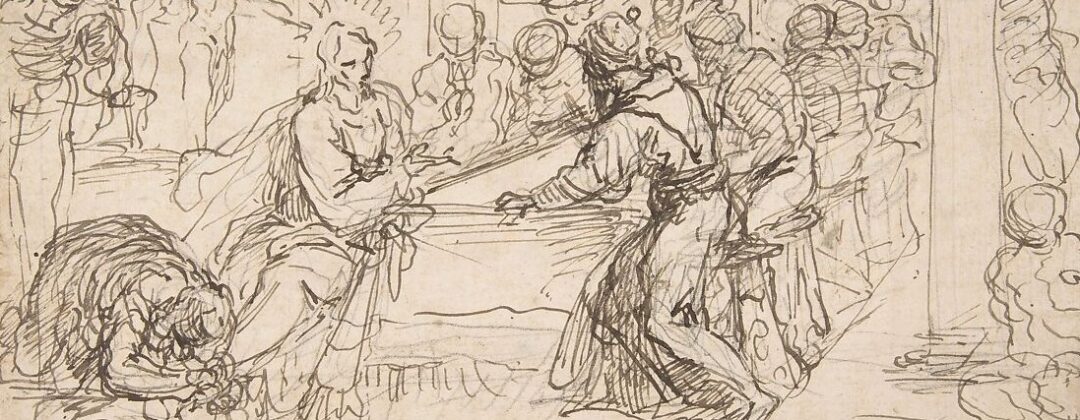
Let the little children come

Now they were bringing even infants to him that he might touch them. And when the disciples saw it, they rebuked them. But Jesus called them to him, saying, “Let the children come to me, and do not hinder them, for to such belongs the kingdom of God. Truly, I say to you, whoever does not receive the kingdom of God like a child shall not enter it.”—Luke 18:15-17, ESVMaybe it’s just me, but I think we find it easier to ding the disciples here than we ought to. After all, we know they shouldn’t have done this—Jesus tells us so—but too often, we don’t stop and think about why they did it. We don’t have to, because we don’t hear what they heard: babies crying (if not screaming) as their mothers struggle through the crowds to get to Jesus; bigger kids running around, shrieking, laughing, crying, throwing themselves on the ground; probably a few of them coming up to Jesus, climbing up in his lap, tugging on his robe, and asking him off-the-wall questions. We don’t hear the disruptions or see the distractions, because they’re between the lines—but kids being kids, you can bet this wasn’t a quiet, peaceful scene. If you stop to think about it, you can see where the disciples were coming from. No doubt they saw all these kids as interruptions, disruptions, distractions, interfering with the real work Jesus was doing—not as part of that work; and so they tried to push the kids out of the way so Jesus could get on with the important stuff.Jesus, of course, rebukes them for that, and in the process he identifies the root problem underlying their attitude: pride. Children have no social status, so they can’t do anything for you; if Jesus is spending his time with children, that’s time taken away from teaching and ministering to adults who do have status in society, who can increase his social standing and the respect he receives as an important and influential teacher and scholar—and thus, not incidentally, raise the standing of his disciples, as well. Part of their concern, Jesus sees, is that they want people around Israel to respect them, to look up to them, to admire them—“See Thomas over there? He’s studying under Jesus.” “Oooh, impressive!”—and Jesus taking the time to bless and teach children does absolutely nothing for that, because children don’t really count. That’s not to say they weren’t valued, or that they weren’t loved—they were; but they had no legal standing, no social standing, no reputation, no right to their own opinions, indeed, no rights to be considered at all. As such, welcoming children just wasn’t a priority for the disciples.You can see where they’re coming from, but Jesus will not let their resistance stand. “Let the children come,” he says, “and don’t hinder them.” Let them come, because the kingdom of God is for them, too; let them come, because as Matthew 18 tells us, whoever welcomes a child in Jesus’ name welcomes Jesus, while anyone who drives them away bears some of the responsibility for their sin, and thus is open to judgment. This isn’t just a matter of bringing them to church and warehousing them in the basement doing crafts while the grownups are in worship, either. That kind of approach brings children to church but not to Christ; I’m convinced it’s much of the reason why we see so few people between the ages of 18 and 30 in our churches in this country, because they’ve grown up in a church that, from the only perspective they’ve been given, has no Christ in it.No, letting the children come to Jesus is a two-part responsibility, I think. One, it means loving them the way Jesus does—which means the focus has to be on what’s best for them, not what’s most comfortable and convenient for the grownups. This is harder than it sounds, because we have a real pattern in this country of doing things in the name of children that aren’t really about them. It’s all well and good to say that children are the future, but too often that comes with the unspoken corollary that we grownups are the present. We need to begin by acknowledging that our children count in the present, too; the kids in the church are our equals in the body of Christ, and “Love your neighbor as yourself” and “Consider others more significant than yourself” apply to them just as much as they do to anyone else.The other part of letting the children come to Jesus is discipling them—and he himself told us what he expects from us there. Here’s the Great Commission as translated by Eugene Peterson in The Message:

“Go out and train everyone you meet, far and near, in this way of life, marking them by baptism in the threefold name: Father, Son, and Holy Spirit. Then instruct them in the practice of all I have commanded you. I’ll be with you as you do this, day after day after day, right up to the end of the age.”

Children’s ministry is not about keeping children out of sight, out of earshot, and out from underfoot; it’s not even about teaching them to be nice to each other and quiet in church, though those things have their place in the process. It’s about training them in this way of life, instructing them in how to live out everything that Jesus has commanded us, teaching them what it means to follow Jesus, day after day after day, week after week after week, right up to the end of the age. It’s about, in other words, nothing less than discipleship, raising the children of the church to live as saints of God; it is, or should be, all of a piece with what we do in the rest of our ministry as the church. And there’s no clause in there to say, “Only the easy ones—only the ones who already know how to behave—only the ones you’re already comfortable having around.” Indeed, the ones who make us most uncomfortable, the ones who haven’t been taught how to behave, the ones full of anger they don’t know how to express against parents who have betrayed them and let them down, though they’re the hardest to reach, are the ones we have to try hardest to love; because if we don’t take them in, who will?

The adolescent atheism of the self-impressed

Atheism is a profitable subject these days, having launched a number of bestsellers—and not only by the likes of Christopher Hitchens and Dr. Richard Dawkins; the notoriety of their books has created corresponding interest in books by Dr. Alister McGrath (The Dawkins Delusion) and the Rev. Tim Keller (The Reason for God), among others. Indeed, the Rev. Keller’s book currently stands at #18 on the New York Times bestseller list and #56 overall on Amazon.com, which wouldn’t have happened without the conversation Dr. Dawkins et al. began. There is more of a market for serious apologetics in this country than there has been probably in decades, and we owe it all to enemies of the faith.

As I stop to consider that fact, I can’t help thinking that for all the outrage from some quarters directed at folks like Hitchens, Dr. Dawkins, Sam Harris and Dr. Daniel Dennett, the end result of their efforts may well be to boost the church rather than atheism. I’ve protested before the intellectual shoddiness of the “new atheists” in their engagement with theology, philosophy and history; what I hadn’t noticed was how shoddy their atheism itself is. Georgetown’s John F. Haught, writing in The Christian Century, points out that they essentially want to throw out God but keep all the trappings; Marx would have called them incurably bourgeois, and there’s no doubt that they lack either the insight (into what they’re really asking) or the courage (to face that insight) of older atheists like Friedrich Nietzsche and Jean-Paul Sartre. Hitchens and his confréres think their critique of religion is original and radical, and are quite impressed with themselves for it (as indeed they seem to be in general); but the truth is, compared to Nietzsche in particular, they’re pikers. Their atheism, far from being the evidence of maturity they appear to believe it to be, is essentially adolescent in character, founded less on a serious engagement with the world than on a visceral rejection of things they don’t like. On an intellectual level, it simply doesn’t measure up to the wealth of Christian apologetics; and if reading God Is Not Great or The God Delusion spurs people to go on to read The Dawkins Delusion or The Reason for God, I can’t help thinking that the church will come out best of it in the end.