In defense of the church, part I: Preaching

This post of Barry’s, in response to a meme that’s going around, got me thinking. Church-bashing is a popular thing, and with a fair bit of reason; even the best of churches are human institutions that screw things up and hurt people sometimes, and there are a lot of churches out there which are far from the best. I know there are a lot of folks out there who have been badly burned by churches; I was part of a congregation for several years that had been planted to minister to people who’d been hurt by the church and never wanted to go back. Even for me, remaining in the church is an act of faith; though most laypeople don’t seem to realize it, any pastor will tell you that churches can abuse their pastors just as easily as they can abuse their members (or perhaps even more easily), and I’ve already been burned pretty good once. There were times I thought about leaving the ministry, and times I thought about leaving the church altogether; it was only the grace and the goodness of God that kept me from giving up on everything, so I have an idea where folks are coming from.

I don’t stay in the church because I have found it to be a wonderful place and a wonderful experience; taken all in all, I’ve found it quite uneven. Rather, I stay in the church as an act of faith that God meant what he said when he called us his people, his family, his body, and promised that not even the gates of Hell would prevail against us—and I say that as one who knows full well that those gates threaten us from within as well as from without. However ambivalent I may sometimes be, it remains true through all that Jesus loves the church, and died for her, and that we are called to follow his lead.

All of which is to say, as much as I understand the stones people throw at the church (having fired off a few myself at times), I do believe the church needs to be defended; and I say that not because I’m in the business, of the guild, as it were, but rather despite that fact. However badly we screw it up, as we often do, this is still something God has ordained, and it’s still important that we gather together in worship and fellowship and ministry. Yes, that means friction, which is unpleasant; but that friction is one of the things God uses to sand away our rough edges and polish our strengths. True community—where, as Kurt Vonnegut beautifully said, “the terrible disease of loneliness can be cured”—is not an easy thing, which is why far too many churches don’t try all that hard to create it; but for all that, it’s important for our well-being, and if we will commit to it, it’s a beautiful gift of God.

Unfortunately, we resist it—and this isn’t just a fault of “the institutional church,” it’s also a fault of many of those who leave it—because it challenges us. I do not say this is the reason everyone leaves—not by a long shot—and I’m certainly not presuming to attribute motives to Barry or Erin or indeed any other specific person; but I do say that it’s something I’ve seen (in past churches of which I’ve been a part, among others). Living in community challenges our selfishness, our certainty of our own ideas, and our particular ways of doing things, and a lot of people don’t like that. We tend to want to hang around people who reinforce all those things (which is why the church-growth types advocate building churches out of people who’re as much alike as possible); part of the job of the church is precisely that we challenge each other on such matters, but that’s not something we find comfortable, and so we tend to shy away from it.

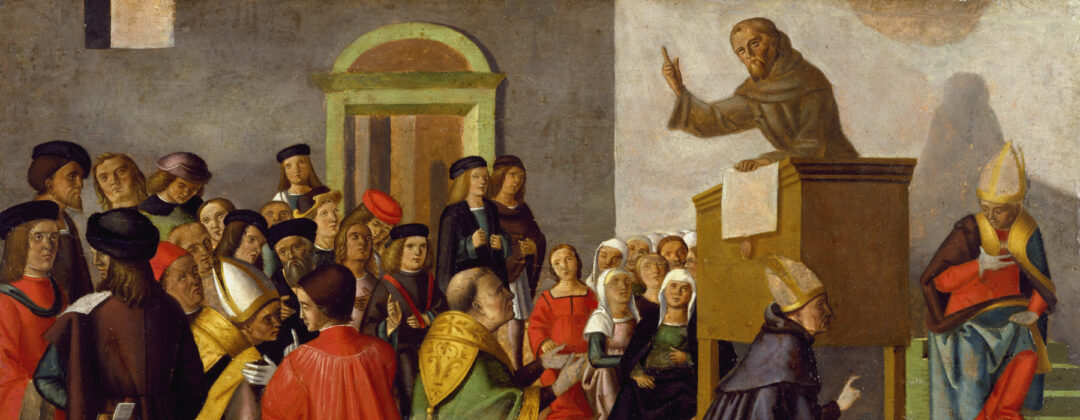
Which is where, oddly enough, I come from in defending preaching. I certainly agree with Barry’s point on the value of discussion and conversation, and I believe that needs to be a major part of the teaching ministry of any church—including something many ministers do (and more have tried to do), discussion and conversation about the sermon. And yet, I do believe that the sermon also has an important place in that ministry. I will grant without argument that “sermons can be dangerous things”—but I will also say that it’s neither my practice nor my experience that “you are only exposed to one point of view, and it is usually presented as the only valid one.” Of course there are preachers who operate that way; I’ve sat under such preaching just like everyone else has. There are more preachers, though, who are so afraid of conflict that they go to the opposite extreme, leaving no punch unpulled and no thought unqualified. And there are a lot of us in the middle, too, who are careful in our preaching to lay out various points of view, to argue respectfully for our own, and to make the limits of our own understanding clear.

That said, as much as I agree there is no place for the dictatorship of the pulpit, there is a need for people who preach with real authority—authority which comes not from them, but from their total submission to the will of God. If we look at Jesus, we see that he consistently challenged people to see what they didn’t want to see and understand what they didn’t want to understand; and the great problem with a teaching ministry that relies solely on discussion and conversation is that it makes it too easy for us to avoid hearing what we don’t want to hear. One of the roles of preaching—probably the most difficult—is to bring people face to face, lovingly and graciously, with where Jesus is challenging them. This isn’t (and can’t be) something we do by our own strength, it’s something the Holy Spirit does through us, and it begins with letting him challenge us as we read the Scriptures; to try to manufacture that in our own strength is spiritual malpractice, pulpit abuse; it’s simply our responsibility as preachers to open ourselves up for God to grab hold of us and challenge us, and then share that as faithfully as we can with the body of Christ, and let God use that as he will. For that kind of preaching, there is no true substitute. For any other kind of preaching, any substitute will do, but for that kind of preaching, there truly is no true substitute.

Missing the point on McCain?

So Bill Keller, executive editor of the New York Times, responded to criticism of the paper’s recent piece on John McCain by . . . apologizing? Explaining that they have actual evidence for their contentions, and giving good reasons why they didn’t print it? Retracting the story? No; he responded by blaming the readers.

Frankly, I was a little surprised by how few readers saw what was, to us, the larger point of the story. . . . [that] this man who prizes his honor above all things and who appreciates the importance of appearances, also has a history of being sometimes careless about the appearance of impropriety, about his reputation.

Now, leave aside for a moment whether you believe this defense or not, or indeed whether you believe it qualifies as a defense or not, and just look at what he’s saying. First, Keller says that Sen. McCain “prizes his honor above all things,” which isn’t quite true but is certainly close enough for journalistic work. Then he says that Sen. McCain “appreciates the importance of appearances,” and then that the point of the story is that the senator actually has a pattern of not appreciating the importance of appearances. It would seem, then, that the assertion that Sen. McCain “appreciates the importance of appearances” rests not on the senator’s behavior, but on the preceding statement that he “prizes his honor.”

In other words, if I’m parsing this correctly, Keller’s defense of his paper’s story rests on the assumption that caring about honor means caring about appearances—which is to say, that honor is the same thing as reputation. I’m not surprised to find the NYT thinking this way, but I very much doubt that Sen. McCain makes this mistake; indeed, if he did, he would never have ended up with the public persona he has. You don’t earn the label of a straight-shooting maverick who’ll offend your friends as soon as your enemies if you’re concerned about appearances; that one is earned precisely by caring about the reality of honor so much that you’re willing to let your reputation swing in the wind. As the sci-fi/fantasy author Lois McMaster Bujold has one of her characters say,

Reputation is what other people know about you. Honor is what you know about yourself. Guard your honor; let your reputation fall where it may.

I think Sen. McCain knows the truth of that; demonstrably, the New York Times doesn’t. We’d be better off if they did.

Becoming like children

At that time the disciples came to Jesus and asked, “Who is the greatest in the kingdom of heaven?” He called a little child and had him stand among them. And he said: “I tell you the truth, unless you change and become like little children, you will never enter the kingdom of heaven. Therefore, whoever humbles himself like this child is the greatest in the kingdom of heaven.”—Matthew 18:1-4, NIVOver the centuries, people have taken Jesus’ words a lot of different ways; as the commentator Ulrich Luz has dryly noted, “every age to a great degree has read into the text its own understanding of what a child is. . . . For the most part the interpreters ask not what children are like; they ask instead what children should be. More often than not they read the text as if it said: ‘Become like good, well-behaved children.’ . . . Only infrequently do [they] remember that actual children can be quite different.”Part of the problem is with that word translated “little.” When we see “little children,” we think “young children,” but that’s not what’s in view here; what the word really means is “lowly”—one who is “insignificant, impotent, weak, and . . . in poor circumstances.” The point here is that children in that society had no social standing—nor for that matter legal standing; they were essentially property of their parents—and in fact weren’t quite regarded as fully human; they were seen as incomplete people, still unfinished. They were insigificant, physically weak, legally powerless, and utterly dependent on others. That’s why, elsewhere in the gospels, the disciples didn’t want Jesus “wasting” his time on them. But Jesus, as he so often does, flips that on his disciples and says, essentially, “I’m not wasting my time at all—you are, because your focus is in the wrong place. You’re worried about what the rich and the powerful folk think of you, and wanting to be like them—wanting to be great in the world’s eyes—when you ought to be looking at these children and learning from their example. You want to be great in the kingdom of God? Become like them—choose to be lowly. Set aside the world’s standards of importance, love those who can’t do anything for you, stop seeking honor and significance in the world’s eyes, acknowledge that you are wholly dependent on God and place all your trust in him, and serve others. Come to God not because you think you’ve earned it, but simply in the confidence that you are loved even though you haven’t.” That’s the life Jesus calls us to live; that’s the life of a child of his kingdom.

“Louder doesn’t make you right”

Kudos to Chris Rice for this one—one of his best, I think.

You Don’t Have to YellSo-called reality,
Right there on my TV;
If that’s how life’s supposed to be, well,
Somebody’s lyin’.
The camera’s on and we can tell,
To keep your fame, you have to yell,
‘Cause tensions build, and products sell, and
We’re all buyin’.
I hope we’re smarter than this . . .

Everybody take a breath;
Why are all your faces red?
We’re missin’ all the words you said;
You don’t have to yell.
Draw your lines and choose your side,
‘Cause many things are worth the fight,
But louder doesn’t make you right;
You don’t have to yell.
Oh, you don’t have to yell.

I tuned in to hear the news—
I don’t want your point of view;
If that’s the best that you can do, then
Something’s missin’.
Experts on whatever side,
You plug your ears, you scream your lines;
You claim to have an open mind, but
Nobody’s listenin’.
Don’t you think we’re smarter than this?

Chorus

Everybody take a breath;
Why are all your faces red?
We’re missin’ all the words you said;
You don’t have to yell.
(If everyone will take the step,
Back away and count to ten,
Clear your mind and start again,
We won’t have to yell.)
Draw your lines and choose your side,
‘Cause many things are worth the fight,
But louder doesn’t make you right;
You don’t have to yell.
Oh, you don’t have to yell.
Words and music: Chris Rice
© 2006 Clumsy Fly Music
From the album
What a Heart Is Beating For, by Chris Rice

This is how you play the game

It’s been interesting reading the avalanche of media commentary on the New York Timeswould-be hatchet job on Senator John McCain; at bottom, they mostly seem to come down to the conclusion that the Grey Lady just didn’t have the goods, and shouldn’t have let itself be stampeded into running the story without them. At this point, it looks like little harm has been done to the senator’s well-earned reputation as the most difficult man on Capitol Hill. Perhaps more interesting, though, has been watching the McCain campaign’s response, and its sequelae. Almost immediately, they said they were “going to war with the New York Times,” and they have, with deadly efficiency; he was sharp enough to hire Robert Bennett, a veteran of D.C.’s brutal infighting, to represent him, and Bennett has been particularly effective at dismantling the Timescase.

The campaign’s goal has been not merely to defuse this story, but to use it to bring the senator’s conservative critics on board. It’s been working, because at the same time as the campaign has been using this to reel them in, conservative pundits like Rush Limbaugh have also been trying to use the NYT’s attack—to pull Sen. McCain in a more conservative direction. The message is clear (and Limbaugh made it explicit): “Stop trying to be liberal enough to keep the media happy with you—if you’re the Republican nominee, they’re going to hate you and try to take you down regardless. Stand up and be a conservative—you might as well be hanged for a sheep as for a goat.” I think it will work to some extent (I’ve argued before that conservatives can expect this, after all); the interesting thing will be to see to what extent, and how quickly. In any case, watching the maneuvering between the campaign and the conservative media establishment, each trying to leverage this story to shift the other, is a fascinating lesson in how you play the game of politics in this country. One more for the textbooks.

Update: David Brooks has an extremely interesting column in today’s Times on a longstanding, deep, and bitter rift between Sen. McCain’s two long-time chief advisors—his campaign manager, Rick Davis, and the one source mentioned by name in the original Times piece, John Weaver. Though it isn’t clear how, it seems very likely that this vicious rivalry played some part in the story.

The value of experience

The president who came to office with the most glittering array of experiences had served 10 years in the House of Representatives, then became minister to Russia, then served 10 years in the Senate, then four years as secretary of state (during a war that enlarged the nation by 33 percent), then was minister to Britain. Then, in 1856, James Buchanan was elected president and in just one term secured a strong claim to the rank as America’s worst president. Abraham Lincoln, the inexperienced former one-term congressman, had an easy act to follow.

Thank you, George Will. (Though it should be noted, of course, that Lincoln was an extraordinary individual; it need scarcely be said that not every former one-term congressman would have done quite so well.)

Inconvenient truth?

The conventional wisdom is that the earth is warming, that it’s the fault of human activity, and that we need to make major changes to reduce CO2 emissions or we’re heading for disaster. Certainly, that’s the line pushed by the scientific and media establishments, and by much of the political establishment as well; as for the cultural elite, they showed their view of the matter when they gave Al Gore an Oscar for his film expounding that point of view, and then topped it off with the Nobel Peace Prize (in one of the stranger awards in the already strange history of the Nobel Prizes).

Which is a very good thing, if this is a real problem. But is it? Is the science really there? Maybe not. For all the worry about shrinking ice caps, for instance, the ice has come back under the Northern Hemisphere’s coldest winter in decades, which has given it its greatest snow cover in over 40 years. For all the concern about polar bears, their population is up. And for all the insistence that global warming is caused by human CO2 emissions, the temperature data and the CO2 data don’t correlate; that’s why 30 years ago, the alarmists were proclaiming that human CO2 emissions were driving a cooling trend that would send us into another ice age.

The fact of the matter is, we know beyond a doubt that the climate has been heating and cooling all through human history; around the turn of the 17th century, we had a “little ice age” that saw the Thames and the Hudson freeze, while earlier, during the Viking period, Greenland was pleasant enough to warrant the name they gave it. We know that the sun’s behavior varies, and it seems likely that fluctuations in solar activity is one of the major drivers in global temperature change; the fact that other planets of our solar system have also been experiencing “global warming” certainly suggests that this is the case. The driving force behind the global-warming argument appears to be not science, but the wisdom of Sir John Houghton, the first person to chair the UN’s Intergovernmental Panel on Climate Change: “Unless we announce disasters, no one will listen.”

That said, does it necessarily follow that we can ignore the question of CO2 emissions, or other forms of pollution? While I think it’s inappropriate of the establishment to smear dissenters as “in the pay of the oil companies,” there are certainly those who oppose the global-warming argument not because it’s bad science, but because they have their own agendas. As Christians, we should be very careful about that. Regardless of the scientific case one way or the other, we have powerful theological reasons to fight pollution; we know from Genesis that God has not given us this planet, but has rather entrusted it to our care as stewards under his authority, and we will most assuredly be called to account for how we have taken care of it. I believe the earth God has made is much more resilient than we often believe, and that our capacity to damage it permanently is quite a bit less impressive than we, in our twisted pride, tend to think—but that in no way frees us from our responsibility to enhance the earth by our labors rather than diminishing it. Will continuing to pump our pollutants into the air cause catastrophic warming that will kill billions of people? I rather doubt it; but if we continue to do so without doing everything we can to clean up our act (bearing in mind that today’s solutions often produce tomorrow’s problems), we’ll still pay for it in the end.

(Update: here’s an excellent column by Thomas Sowell on the subject of global warming.)

Lenten Song of the Week

Hallelujah! What a Savior!“Man of Sorrows!”—what a name
For the Son of God who came
Ruined sinners to reclaim!
Hallelujah! what a Savior!

Bearing shame and scoffing rude,
In my place condemned He stood,
Sealed my pardon with His blood;
Hallelujah! what a Savior!

Guilty, vile, and helpless we,
Spotless Lamb of God was He;
Full atonement!—can it be?
Hallelujah! what a Savior!

Lifted up was He to die,
“It is finished!” was His cry;
Now in heaven exalted high,
Hallelujah! what a Savior!

When He comes, our glorious King,
All His ransomed home to bring,
Then anew this song we’ll sing:
Hallelujah! what a Savior! Words and music: Philip P. Bliss
HALLELUJAH! WHAT A SAVIOR, 7.7.7.8

Abiding in the light

On my post below on the PC(USA)’s recent church-court rulings, my wife’s Uncle Ben left a comment in which he noted, among other things, that “we all have varying lists of issues A-Z that we consider essential that don’t quite match what other people think are non-essential. Of course, one gets tangled up in that nasty charity stuff, too, even if we can codify essentials. Darn that I Cor 13.” True statement, that, one which was echoed today by the Rev. Paul Detterman, executive director of Presbyterians for Renewal, in a powerful sermon to our presbytery assembly on 1 John 2:1-11. (Unfortunately, no one taped his message, but when I asked him for a copy, he said it would be posted on the website; when it is, I expect I’ll have more to say on it.)

As the Rev. Detterman noted, sin is sin, and it’s “not love but cultural capitulation” to tell people otherwise—and yet, when we let those who disagree with us become enemies and treat them as such, that’s sin too. “By this we may know that we are in [Jesus]: whoever says he abides in him ought to walk in the same way in which he walked. . . . Whoever says he is in the light and hates his brother is still in darkness . . . and does not know where he is going, because the darkness has blinded his eyes.” We may disagree—in fact, we will disagree, there’s nothing more certain than that; but how did Jesus treat those with whom he disagreed? He spoke to them quite sharply, to be sure, but he never stopped loving them; though their hard, cold hearts drove him to his death, that death was for them, too, just as surely as for any of the rest of us. May we also learn to love those who oppose us, even to the point of being willing to lay down our own good for theirs.

Two cheers for political polarization

I know I’ve lamented the polarization of American politics in this space before; but then, I’ve also argued at least once for the value of historical perspective, and with a dose of perspective, I may have to rethink my lament. In a brilliant essay in the Wilson Quarterly titled “In Praise of the Values Voter,” Jon A. Shields (an assistant professor of political science at the University of Colorado-Colorado Springs) makes a strong case that “political polarization has improved civic life”—a statement I would never have thought to read. Apparently, however, our current polarized state, with strong ideological divisions between the two parties, was deliberately induced by activists of the Left who believed, in the words of a special committee of the American Political Science Association, that “the ‘ailment’ of American parties was their absence of ideological cohesion, a condition that had dangerously slowed ‘the heartbeat of American democracy.’” The response to this was an effort to reform the system which was motivated, according to James Q. Wilson, by “a desire to moralize public life.” Such an effort was bound to increase controversy and partisanship, but people like Tom Hayden embraced that, saying it would “vivify” a political system they perceived as demoralized, paralyzed, and devoid of any real meaning.

The irony in all this, as Dr. Shields notes, is that now they and their heirs are “mounting a counterattack against their own revolution,” in large part because “‘values voters’ . . . turned out to have the wrong values.” In Dr. Shields’ analysis, the project launched by the New Left did indeed breathe new life into the American political system—but it did so in large part by strengthening the conservatives they despised; where liberal political scientists assumed that “liberal Democrats would benefit from the hardening of party differences,” the opposite has turned out to be the case, and so now they badly want to push the djinn back in the bottle. Unfortunately for them—but maybe, just maybe, fortunately for our country as a whole, however exhausting the current state of things often is—it ain’t going.

(My thanks to Fr. Richard John Neuhaus for his essay, also excellent, which pointed me to Dr. Shields’ piece.)