




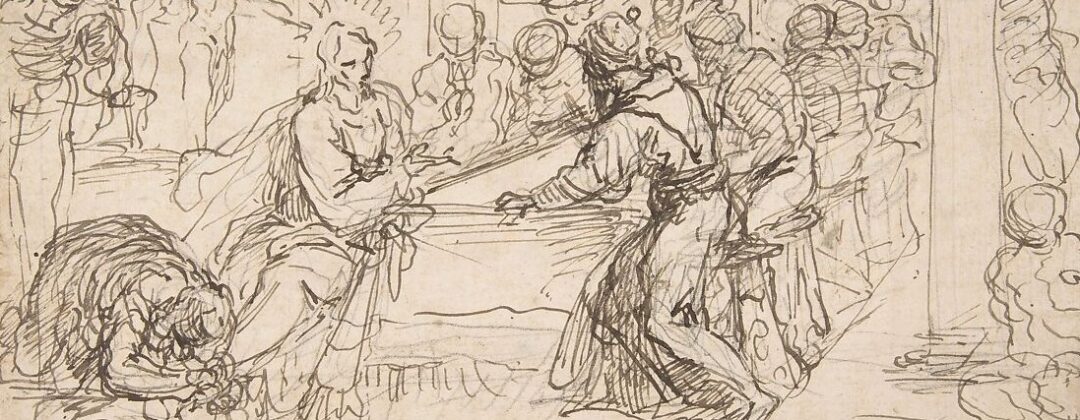





I’ve been spending a lot of time the last few weeks thinking about the fact that this pandemic season of physical distancing and isolation is a Lenten season, and trying to figure out what to do with that. I wasn’t getting a lot of traction until I read an article this week in Christianity Today‘s annual issue for pastors on Evagrius Ponticus and the sin of acedia—which is usually translated “sloth” in English, but means much more than that. I gave myself a while today to think out loud about it.
Waiting Is Not Easy!
Ah, the wit and whimsy of Mo Willems . . .

The God of Sight and Blindness
After healing the man born blind, Jesus said, “I have come into this world for judgment, so that the blind will see and those who see will become blind.” In saying that, he was playing a variation on a theme which appears in a number of places in Scripture—the section often called “Second Isaiah,” chapters 40-55, is one prominent example—but nowhere more importantly than in two psalms, 115 and 135. These are, I believe, the key for us in understanding the language of blindness and sight in the word of God. Listen—this is Psalm 115:2-11.
Why do the nations say,
“Where is their God?”
Our God is in the heavens;
he does whatever he pleases.
Their idols are silver and gold,
the work of human hands.
They have mouths, but cannot speak;
eyes, but cannot see.
They have ears, but cannot hear;
noses, but cannot smell.
They have hands, but cannot feel;
feet, but cannot walk;
nor can they make a sound with their throats.
Those who make them become like them,
and so do all who trust in them.
O house of Israel, trust in the Lord!
He is their help and their shield.
O house of Aaron, trust in the Lord!
He is their help and their shield.
You who fear the Lord, trust in the Lord!
He is their help and their shield.
Do you see? We become like what we worship. Idolatry produces spiritual blindness. This is what Jesus is on about: simply by being who and what he was, he revealed the truth of people’s hearts as they either drew near to him or clung hard to their idols. We don’t think of the Pharisees as idolaters, but they were; their religion—and their place in it—was their idol, and they unhesitatingly chose it over God, and so they were blinded to what was happening right in front of them.
That same reality underlies the story of Elisha and the Syrian army and God’s most remarkable act of deliverance. Please open your Bibles to 2 Kings 6, and let’s walk through that passage this morning; we’ll be looking at verses 8-23. Read more

The Promise of Deliverance
(Genesis 11:27-12:7, 15:1-18, 17:1-16; Romans 4:2-5, 16b-25; Hebrews 11:8-9a)
That’s the scale and scope of God’s plan. That’s the size of his purpose: the redemption of nothing less than everything. As we saw last week, God has been a God of deliverance from the moment our first parents sinned. There’s a popular idea that “the God of the Old Testament” is all about fire and brimstone and judgment and wrath, while Jesus and the New Testament give us a God who’s all about love and mercy and forgiveness—don’t believe it, it’s bunk. Pure tripe. Right from the first, God has been on about redemption and deliverance for those who are enslaved by sin and oppressed by death. Yes, his wrath is a real thing: it’s the wrath of the lover against anyone and anything that hurts the beloved. His wrath is against sin and death. If we cling to our sin kicking and screaming, then his wrath falls on us as well as a consequence; but if we let him work, it becomes the surgeon’s scalpel to cut us free from the power of sin and death. God is in the deliverance business—all in, full stop.

Follow Me!
Note: the video is longer than the audio as it includes a bit more than just the sermon proper.
This is the hinge of the gospel of Luke. To this point, Jesus has had a spectacular ministry career. He has established himself as a teacher who speaks with authority, he’s done spectacular miracles—everything is rolling along beautifully. And then, instead of capitalizing on his success as any smart preacher would, Jesus tossed it all aside and—as Rich Mullins put it—“set his face like a flint toward Jerusalem.” Everything that happens in Luke from now into chapter 19, in what’s commonly called the Travel Narrative, happens on the way to the cross.

Radical Followers
In Teaching a Stone to Talk, in one of my favorite paragraphs ever written by anybody anywhere, Annie Dillard writes,
On the whole, I do not find Christians, outside of the catacombs, sufficiently sensible of conditions. Does anyone have the foggiest idea what sort of power we so blithely invoke? Or, as I suspect, does no one believe a word of it? The churches are children playing on the floor with their chemistry sets, mixing up a batch of TNT to kill a Sunday morning. It is madness to wear ladies’ straw hats and velvet hats to church; we should all be wearing crash helmets. Ushers should issue life preservers and signal flares; they should lash us to our pews. For the sleeping god may wake someday and take offense, or the waking god may draw us out to where we can never return.
It’s in that spirit, I think, that we should come before this passage, because it’s at this point in the Gospel of John that things really start getting bumpy. The gospels tell a story of increasing division between Jesus and the religious folk as they move from skeptical curiosity through entrenched opposition to murderous fury—a division that Jesus doesn’t desire but also doesn’t try to prevent. In John, the major shift happens in chapters 9 through 11. The healing of the blind man in chapter 9, as Deborah showed us two weeks ago, ups the ante for the Pharisees, making him a much more alarming threat to them than he had been. The raising of Lazarus in chapter 11, which Tom will talk about in two weeks, brings the chief priests fully on board with the conviction that Jesus must be killed. And in between? In our passage this morning, we see Jesus put a wedge in the crack between himself and the Jewish leadership and bring the splitting maul down hard.
It’s important to be clear about something here: there’s a difference between being a divisive figure and being a divider. For dividers, turning people against each other is the point—it’s a means to an end, a tactic or strategy in the service of their agenda. Think Lee Atwater, James Carville, Karl Rove. Jesus didn’t desire division; he wasn’t dividing people in order to conquer them. But anyone who stands strongly for truth will be a divisive figure, both loved and hated—and sometimes by the same people at the same time. Dr. King was a divisive figure, because—like Jesus—he spoke truths that many people didn’t want to hear. Great unifiers are great compromisers; and sometimes, as with the Constitution, they compromise not only their principles but their integrity for the sake of unity.
Jesus is the light of the world, and—as John makes very clear—light divides the world into those who love the light and those who love the darkness, just by existing. Read more

Starkindler
There’s a story about a young pianist who was working on a piece by Bach. After the recital, she said to her teacher, “Thank goodness we’ve finished Bach.” Her teacher looked at her and said firmly, “My dear, one never finishes Bach.” Christians have the tendency to approach the fundamental truths of our faith in this way, as if there comes a point where we can look at them and say, “I’ve learned this—I can move on to the next thing.” The truth that we’re saved by God’s grace alone and we live by his grace alone, for instance, is something we need to keep coming back to and re-learning because the sinful part of us keeps pushing it out of our minds.
That’s one reason it’s a good thing we have those headings of the VSF creed up on the wall: we need the continual reminder that God is bigger. We do well to take that a bit further and remind ourselves that Jesus is bigger. The universal temptation is to make God safe, and perhaps especially to make Jesus safe—or maybe it’s just especially easy to do with Jesus. We think in comparisons, and so when we read the stories of Jesus as a human being, we try to fit him into our normal frame of reference. Even if we believe he was fully God, we have no model anywhere in view for what that looks like, and so our natural tendency is to imagine Jesus as merely human. John’s aim in beginning his gospel is to write about Jesus in a way that prevents that tendency from obscuring our view of the greatness and uniqueness of Jesus.

In the Lord, for the Lord, from the Lord
I love preaching on this passage. That might sound a little strange, given the amount of ill feeling it generates in some parts of the church, but that’s actually why I love preaching on it. There are some passages of Scripture that have gotten jammed up over the years in interpretations that don’t actually make sense—Jim Eisenbraun pointed me to another one this year, in Job 42—and it’s a joy and delight to be able to come along and say, “You keep using that passage. I do not think it means what you think it means.” (Gotta keep the Princess Bride references going here.) There are interpretations of Scripture which ought to be inconceivable that are widely assumed to be obviously true, and they need to be set right.
That’s what we’re dealing with in Ephesians 5. It’s a widely-misused passage which illustrates two common pathologies of biblical interpretation. One is the mindset which reads the Bible as an instruction manual from which we are to extract “biblical principles” to follow in our lives. With that approach, the instant the brain sees the word “wives,” the mental guillotine drops and everything that follows is cut completely out of its context. It’s as if Paul said, “OK, I’m done talking about all this grace and unity stuff; now I’m going to sit down and write you a rulebook on ‘how marriage is supposed to work.’” That’s how it’s frequently read, as if it were a marriage manual that got mixed up with the letter and published by mistake.
If we’re going to take this passage seriously as Scripture, we can’t do that. We need to understand it in context—both the context of the letter, in which it serves a purpose in Paul’s overall argument, and its historical and cultural context. Ephesians wasn’t written five years ago by a youth pastor in Iowa, after all. We need to ask ourselves how the Ephesians would have heard this passage, which was written to address their questions, concerns, and culture, not ours. When we ignore the context of a passage, we almost always produce interpretations which serve the agenda of the interpreter rather than challenging it. In this case, that has historically meant two profound errors: first, the idea of absolute unilateral submission of wives to husbands—the husband is supposed to be the lord of the house; and second, a focus on wives rather than husbands despite the fact that Paul addresses eight verses to husbands and only three to wives.

Body-Building
To my way of thinking, this is one of the two hardest passages in Ephesians to preach. The other is the one I’m preaching on next month. I don’t mention that because I’m fishing for sympathy—I volunteered—but because there’s one point to be made about both of them; I’ll talk about that later. In general, though, the challenges are quite different. With Ephesians 5, the problem is the way the passage has been misused and abused through the centuries. That one, you might call the “No, Paul isn’t who you think he is and he isn’t saying what they’ve told you he’s saying” sermon. Here in Ephesians 4, the issue is with the text itself, and one you may have already seen: does Paul even know how to read? Compare the text of Psalm 68:18 with the way Paul quotes it, and you have reason to wonder.
To understand what’s going on here, we need to begin—as always—with the context. Read more

The Mystery of the Church
OK, Tychicus, are you ready to start? Listen, brother, I’m really sorry your hand cramped up so badly . . . I have to admit, it’s the first time I’ve ever seen a pen fall out of someone’s hand like that. —But you’re better now? Good. Thank you.
Just let me put myself in the proper frame— Yes, I’m going to take a minute to think about—well, I know we’re planning to send this around all the churches in the province of Asia, but “Asians” sounds strange, and the only church I really know is Ephesus; I’m just going to call them “Ephesians.” If I can fix them in my mind’s eye, it will be like I’m talking directly to them. You know that’s how I work.
No, I don’t want to sit down, I think better standing up. —Something to lean against? You’re right, I’m not feeling well; that might be a good idea. —Though I think you’re just hoping if I walk less, I’ll talk less.
So . . . where did you put the copy you made? —Oh, right, I’m holding it. Thank you. Now, where were we? . . . Hmmmm . . . Tychicus, I never finished my prayer for the Ephesians—I must have forgotten I was writing a prayer, because I went off on a tangent. It was a good tangent, but still . . . I wonder why we didn’t catch that? —You caught it? Of course you did. Why didn’t you tell me? —Because it was a good tangent and you didn’t want to interrupt me? Well, that’s something, anyway.
Still, I need to finish that prayer. So, let’s see, where did I leave off—mutter mutter “no longer exiles and resident aliens, fellow citizens with the members of the house of God, built on the apostles and prophets, Christ Jesus the cornerstone, being built by the Spirit into a temple for God.” OK. Ready? Good. Continuing: