



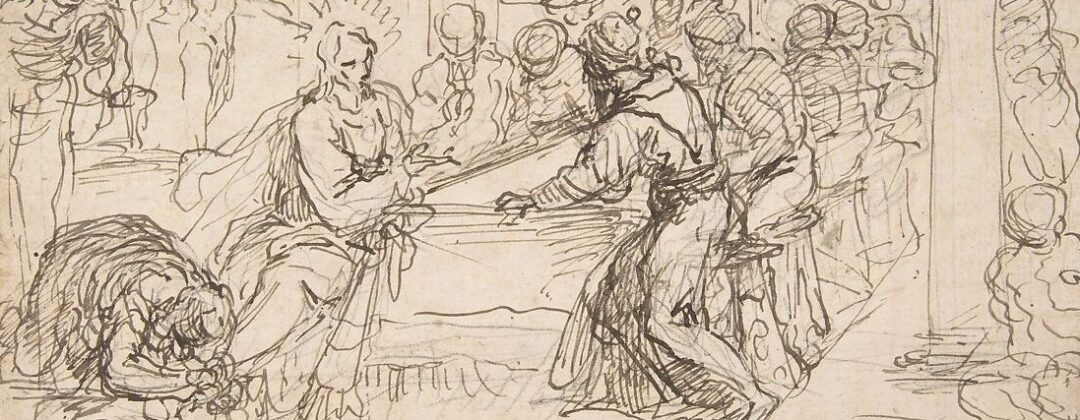





Suffering and our hope of glory

Has it ever occurred to you how much of what they show on TV is about suffering? I don’t mean the programs, necessarily (though many of them are, too)—I mean the commercials. For one thing, many of them are so bad, they make you suffer . . . More than that, though, suffering is really what they’re about. First, you have all the drug commercials. “If you suffer from depression . . .” with these grey-lit shots of gloomy, exhausted people—then, after they tell you about the drug, the same people in the sunshine with smiles on their faces. “If you suffer from high blood pressure,” or “high cholesterol,” or whatever—they all boil down to the same thing: Got a problem? Take a pill. Sure, there are side effects, but they aren’t as bad as this, are they?Alongside those, though not as frequent, are the “pay an expert” ads. The ones that still come to my mind, though I haven’t seen them in ages, are ads for “the law offices of Buckland & Shumm” that used to run incessantly during Perry Mason on the Bellingham station. Different places have different lawyers, but the same basic message: has someone hurt you? Sue their pants off. We’ll be happy to take all their money for you, and we’ll even let you have some of it! Also in this category are ads for counseling services and the like, and these I have a lot more respect for; I’ve been through counseling a couple of times myself (I came out still odd, but happier about it), and I know just how much good a good counselor can do. What does concern me, though, is that there’s still the idea here that suffering is a problem which needs to be fixed, and that you need an expert to fix it for you. There are times when that’s true; there are also a good many counselors who are wise enough not to foster that idea when it isn’t; but there are too many more who aren’t.As well, we have the bread and butter of commercial advertising: Is there a need in your life? Buy our product. Dishwasher soap not getting your glasses clean? Not attractive enough to the opposite sex? Feeling flabby and out of shape? Driving an old, uninteresting car? Losing your hair? Losing your energy? Why suffer? Buy Our Product, and all will be well.Besides these, I can think of one other type of TV ad that’s all about suffering: political ads. (And no, I don’t primarily mean your suffering, real though that no doubt is.) When it comes to negative political ads, it seems to me there are two basic variants. One, of course, is the “my opponent is scum” ad, like this one from the current Senate race in Minnesota:

The more common form of negative advertising, however, is the “distort the record” ad, which makes all sorts of exaggerated statements about the opponent’s political positions and actions that really boil down to one premise: you’re suffering, and either my opponent is the reason why, or if they win this election, they’ll make it worse. These sorts of ads give us a third response to suffering: if you can’t take a pill or pay an expert to fix it, then find someone to blame. (Just imagine if we combined these with the lawyer ads . . . “Hi, I’m Joe Schmo, and I’m running for Congress. My opponent beats up old ladies and burns down their houses. Vote for me, and after I win, I’ll sue him for millions of dollars on your behalf.” The possibilities are endless.)All these ads run off the underlying assumption of our society that we shouldn’t suffer, that we shouldn’t have to, and that if we do, something’s wrong—something needs to be fixed, somebody’s going to pay, something has to change. In the most extreme cases, this gives us the euthanasia movement, which tells us that if we’re suffering and it can’t be fixed, we can’t change it, then we shouldn’t want to live anymore. In lesser cases, we’re urged to take a pill, see a specialist, call a lawyer, file a complaint. Behind it all is the idea that a life without serious suffering is the norm, or ought to be, and that we should expect no less; that creates a gap between expectations and reality, which creates stress, which only makes matters worse.By contrast, the apostle Paul had a very different view of suffering. I don’t imagine he enjoyed it any more than anyone else does, but he didn’t see it as something to be rejected, to be avoided or fixed or blamed on someone else. Look at Colossians 1:24-29:

Now I rejoice in my sufferings for your sake, and in my flesh I am filling up what is lacking in Christ’s afflictions for the sake of his body, that is, the church, of which I became a minister according to the stewardship from God that was given to me for you, to make the word of God fully known, the mystery hidden for ages and generations but now revealed to his saints. To them God chose to make known how great among the Gentiles are the riches of the glory of this mystery, which is Christ in you, the hope of glory. Him we proclaim, warning everyone and teaching everyone with all wisdom, that we may present everyone mature in Christ. For this I toil, struggling with all his energy that he powerfully works within me.

“I rejoice in my sufferings for your sake.” That doesn’t mean he wanted to suffer, but that in the midst of suffering, as bad as it was, he was able to find joy—not despite his suffering, but in it; he was able to find his suffering a cause for joy. Why? Because he saw a purpose in it, a reason for it, and a benefit to it. He isn’t suffering for no reason, and his suffering isn’t meaningless; he’s suffering for the sake of the Colossians, for the sake of the whole church, and for Christ.But what purpose, what reason, what benefit, could he have found in his suffering? The answer to that question begins with one key fact: Paul was a faithful servant of Jesus Christ, and there was no doubt in his mind that he was doing what God had called him to do—and he understood all his sufferings, all his afflictions, in the light of that fact. Much that he suffered, of course, was in direct response to that, as his opponents tried multiple times to destroy him (and came very close once or twice); but even those pains which came in the normal course of life, such as the hardships of life on the road, came in the course of a life devoted to serving God. With everything he did focused on following Jesus, he could and did regard all his suffering as suffering for Christ; and so the mission that gave his life meaning also gave meaning to his suffering.This is why he says, “in my flesh I am filling up what is lacking in Christ’s afflictions for the sake of his body, that is, the church.” Paul is not saying here that Jesus’ crucifixion was insufficient for the salvation of his people (and still less that Paul’s own sufferings are necessary to complete that work); rather, he’s drawing on the Jewish concept of “the woes of the Messiah.” In Jewish thought, this was the time of distress and suffering that would precede the coming of the Messiah to put all things right and make all things new; a roughly similar concept in Christian thought is the time of the Tribulation. The idea was that it was necessary to pass through this time in order to enter the kingdom of God. What Paul’s working with here is the thought that there is a definite measure of suffering that must be filled up before Christ will come again, and that in taking on more than his own share of suffering, absorbing more than his share of affliction, he’s reducing the amount that his fellow Christians will have to endure.This is a strange thought to us (though I would think it must have made sense to the Colossians), but it underscores two key points: first, suffering for Christ is not something to be avoided, but something we need to accept, and even embrace, because when we suffer for Christ, it draws us close to him. Paul makes this explicit in Philippians 3:10, where he writes, “I want to know Christ, the power of his resurrection and the participation in his sufferings, by being conformed to his death.” We cannot experience the power of Christ’s resurrection, which we have through the Spirit of God, if we are unwilling to walk his path of suffering; these two are inextricably linked. As well, if we suffer for Christ, then we suffer with Christ—we do not suffer alone, but in our suffering, we share in his suffering—and so we are drawn closer to him, we come to know him and share in his life in a deeper and more intimate way than we ever could otherwise.The key is that, in joys and in sorrows, whatever may come, we keep focused on Christ. That’s the example Paul sets us here; and note the way he uses his example to help set the Colossians straight, and bring them back to that focus on Christ. Remember, they’ve fallen in with these teachers who are promising them an experience of God in his glory if they will just obey all their rules and regulations; the teachers are holding up those rules and regulations as the Colossians’ hope of a fleeting experience of glory. Paul points them, and us, to a far greater hope: the true riches of the mystery of God are not locked away from everyone except the select few who can manage to obey him well enough—instead, they’re available to everyone, because the mystery is that God was in Christ, and by his Holy Spirit, Christ is in you. That, Paul says, is the hope of glory: the promise that we can live life, even in this fallen, broken world, in the constant presence of our loving God, and that when death comes, we will be gathered fully into his presence, able fully to experience his glory—and not only to experience it, but to share in it. That’s the hope, that’s the promise, that enables Paul to rejoice in his sufferings, because he knows that whatever he may suffer now as a result of his service to Christ will only contribute to the glory he will experience later; and it’s the hope and promise that enables us to do the same. It’s the promise we were given by Christ himself, who is our sure and certain hope of glory.

For something brighter

Here’s some videos by a group I really enjoy, Newfoundland’s Great Big Sea. (I don’t make expansive claims for the brilliance of their lyrics, but they’re Newfoundland folkies at heart, and I like their sound.)
Ordinary Day

Goin’ Up

Lukey

Feel it Turn

Everything Shines

Walk on the Moon

And the deal falls apart

Dump the lot of them. Dump the Republicans who voted against it and called their cowardice “conservative”—what, do they think there’s going to be a better option to come along?—dump the 95 Democrats in the House who followed them down the rat hole, and dump the House “leadership” of both parties who couldn’t get the job done. Along with them, kick the Senate “leadership” to the curb who couldn’t even get a vote off. These are the guys who created the problem, and they’re the ones who refused to fix it until it came to a crisis, and now they won’t put their careers on the line to fix it when it is a crisis? What do we need them for? What good are they?Update: OK, it appears I was too hard on the House GOP, though I still think they did wrong: it appears Nancy Pelosi was trying to set them up. For all her productive efforts to pull the deal together, she never lifted a finger to get her own party to vote for it. In fact, she did everything possible to make it painless for House Democrats to vote against it. Then, just before the vote, she gave a speech tearing into the GOP, angering and alienating all those Republican Representatives whose votes she’d been soliciting. Clearly, she wanted the bill either to fail—and to be branded a Republican failure—or to pass in such a way that it could be blamed on the GOP as a Republican bill. I’m still very unhappy with the House GOP—again, do they think this failure is likely to lead to a better outcome?—but given that a lot of them really didn’t believe in the bill, I can understand why so many voted against it, given the stunts Speaker Pelosi was pulling; and given her behavior, there’s no question in my mind that the blame for this one belongs squarely on her shoulders.At this point, I’m hoping that my pessimism is wrong and that Joseph Calhoun is right:

We are not on the verge of a new depression. The housing bubble collapse in California, Florida and a few other states is not enough to bring down the entire banking system. Investors who made mistakes in these markets should be held responsible and those who navigated the Fed-distorted market should be rewarded for their wisdom and prudence. Enacting the Paulson plan will not allow that to happen and our economy will suffer for it in the long run. The Japanese tried to prop up failed banks in the aftermath of the bursting of their twin bubbles and the result was 15 years of stagnation. Why are we emulating a strategy that is a demonstrable failure? A better alternative would be to allow capitalism to work as it should and stop the interventions of the Fed in the money market. Trust capitalism. It works.

He’s a minority voice in his opinion that the economy can get through this without a major infusion of capital; but he could still be right. Here’s hoping.

The Hope of Glory

(Isaiah 49:1-6; Colossians 1:24-29)

Has it ever occurred to you how much of what they show on TV is about suffering? I don’t mean the programs, necessarily (though many of them are, too)—I mean the commercials. For one thing, many of them are so bad, they make you suffer . . . More than that, though, suffering is really what they’re about. First, you have all the drug commercials. “If you suffer from depression . . .” with these grey-lit shots of gloomy, exhausted people—then, after they tell you about the drug, the same people in the sunshine with smiles on their faces. “If you suffer from high blood pressure,” or “high cholesterol,” or whatever—they all boil down to the same thing: Got a problem? Take a pill. Sure, there are side effects, but they aren’t as bad as this, are they?

Alongside those, though not as frequent, are the “pay an expert” ads. The ones that still come to my mind, though I haven’t seen them in ages, are ads for “the law offices of Buckland & Shumm” that used to run incessantly during Perry Mason on the Bellingham station. Different lawyers out here, but the same basic message: has someone hurt you? Sue their pants off. We’ll be happy to take all their money for you, and we’ll even let you have some of it! Also in this category are ads for counseling services and the like, and these I have a lot more respect for; I’ve been through counseling a couple of times myself (I came out still odd, but happier about it), and I know just how much good a good counselor can do. What does concern me, though, is that there’s still the idea here that suffering is a problem which needs to be fixed, and that you need an expert to fix it for you. There are times when that’s true; there are also a good many counselors who are wise enough not to foster that idea when it isn’t; but there are too many more who aren’t.

As well, we have the bread and butter of commercial advertising: Is there a need in your life? Buy our product. Dishwasher soap not getting your glasses clean? Not attractive enough to the opposite sex? Feeling flabby and out of shape? Driving an old, uninteresting car? Losing your hair? Losing your energy? Why suffer? Buy Our Product, and all will be well.

Besides these, I can think of one other type of TV ad that’s all about suffering: political ads. And no, I don’t primarily mean your suffering, real though that no doubt is. Rather, stop and think about negative political ads for a minute, because they tend to be about playing on the suffering, real or perceived, of the voters they’re trying to persuade. The most common kind of negative ad is the “distort the record” ad, which makes all sorts of exaggerated statements about the opponent’s political positions and actions that really boil down to one premise: you’re suffering, and either my opponent is the reason why, or if they win this election, they’ll make it worse. These sorts of ads give us a third response to suffering: if you can’t take a pill or pay an expert to fix it, then find someone to blame. (Just imagine if we combined these with the lawyer ads . . . “Hi, I’m Joe Schmo, and I’m running for Congress. My opponent beats up old ladies and burns down their houses. Vote for me, and after I win, I’ll sue him for millions of dollars on your behalf.” The possibilities are endless.)

All these ads run off the underlying assumption of our society that we shouldn’t suffer, that we shouldn’t have to, and that if we do, something’s wrong—something needs to be fixed, somebody’s going to pay, something has to change. In the most extreme cases, this gives us the euthanasia movement, which tells us that if we’re suffering and it can’t be fixed, we can’t change it, then we shouldn’t want to live anymore. In lesser cases, we’re urged to take a pill, see a specialist, call a lawyer, file a complaint. Behind it all is the idea that a life without serious suffering is the norm, or ought to be, and that we should expect no less; that creates a gap between expectations and reality, which creates stress, which only makes matters worse.

By contrast, the apostle Paul had a very different view of suffering. I don’t imagine he enjoyed it any more than anyone else does, but he didn’t see it as something to be rejected, to be avoided or fixed or blamed on someone else. Instead, we see him say here (and in other places), “I rejoice in my sufferings for your sake.” That doesn’t mean he wanted to suffer, but that in the midst of suffering, as bad as it was, he was able to find joy—not despite his suffering, but in it; he was able to find his suffering a cause for joy. Why? Because he saw a purpose in it, a reason for it, and a benefit to it. He isn’t suffering for no reason, and his suffering isn’t meaningless; he’s suffering for the sake of the Colossians, for the sake of the whole church, and for Christ.

But what purpose, what reason, what benefit, could he have found in his suffering? The answer to that question begins with one key fact: Paul was a faithful servant of Jesus Christ, and there was no doubt in his mind that he was doing what God had called him to do—and he understood all his sufferings, all his afflictions, in the light of that fact. Much that he suffered, of course, was in direct response to that, as his opponents tried multiple times to destroy him (and came very close once or twice); but even those pains which came in the normal course of life, such as the hardships of life on the road, came in the course of a life devoted to serving God. With everything he did focused on following Jesus, he could and did regard all his suffering as suffering for Christ; and so the mission that gave his life meaning also gave meaning to his suffering.

This is why he says, “in my flesh I am filling up what is lacking in Christ’s afflictions for the sake of his body, that is, the church.” Paul is not saying here that Jesus’ crucifixion was insufficient for the salvation of his people (and still less that Paul’s own sufferings are necessary to complete that work); rather, he’s drawing on the Jewish concept of “the woes of the Messiah.” In Jewish thought, this was the time of distress and suffering that would precede the coming of the Messiah to put all things right and make all things new; a roughly similar concept in Christian thought is the time of the Tribulation. The idea was that it was necessary to pass through this time in order to enter the kingdom of God. What Paul’s working with here is the thought that there is a definite measure of suffering that must be filled up before Christ will come again, and that in taking on more than his own share of suffering, absorbing more than his share of affliction, he’s reducing the amount that his fellow Christians will have to endure.

This is a strange thought to us (though I would think it must have made sense to the Colossians), but it underscores two key points: first, suffering for Christ is not something to be avoided, but something we need to accept, and even embrace, because when we suffer for Christ, it draws us close to him. Paul makes this explicit in Philippians 3:10, where he writes, “I want to know Christ, the power of his resurrection and the participation in his sufferings, by being conformed to his death.” We cannot experience the power of Christ’s resurrection, which we have through the Spirit of God, if we are unwilling to walk his path of suffering; these two are inextricably linked. As well, if we suffer for Christ, then we suffer with Christ—we do not suffer alone, but in our suffering, we share in his suffering—and so we are drawn closer to him, we come to know him and share in his life in a deeper and more intimate way than we ever could otherwise.

The key is that, in joys and in sorrows, whatever may come, we keep focused on Christ. That’s the example Paul sets us here; and note the way he uses his example to help set the Colossians straight, and bring them back to that focus on Christ. Remember, they’ve fallen in with these teachers who are promising them an experience of God in his glory if they will just obey all their rules and regulations; the teachers are holding up those rules and regulations as the Colossians’ hope of a fleeting experience of glory. Paul points them, and us, to a far greater hope: the true riches of the mystery of God are not locked away from everyone except the select few who can manage to obey him well enough—instead, they’re available to everyone, because the mystery is that God was in Christ, and by his Holy Spirit, Christ is in you.

That, Paul says, is the hope of glory: the promise that we can live life, even in this fallen, broken world, in the constant presence of our loving God, and that when death comes, we will be gathered fully into his presence, able fully to experience his glory—and not only to experience it, but to share in it. That’s the hope, that’s the promise, that enables Paul to rejoice in his sufferings, because he knows that whatever he may suffer now as a result of his service to Christ will only contribute to the glory he will experience later; and it’s the hope and promise that enables us to do the same. It’s the promise we were given by Christ himself, who is our sure and certain hope of glory.

A win-win rescue plan

The biggest mistake the federal government has made with respect to its economic rescue plan has been allowing it to be described as a “bailout.” It isn’t; rather, it’s a plan for the government to interject necessary capital into our financial markets, thereby enabling them to get through this period without collapsing, by buying assets. The problem for the markets is that these assets have dropped in value, but that doesn’t mean they have no value; they will generate income for taxpayers while they’re in government hands, and assuming they’re purchased at a reasonable price, it should be possible at some point in the relatively near future for the government to sell them at a profit. As such, this isn’t really a case of the government giving away hundreds of billions of dollars; rather, it’s a case of the governmentinvesting that money in order to bridge our economy across a difficult period and, ultimately, pay down some of the national debt.

That’s why it’s good news that a deal appears to be coming together for a clean plan—one that includes additional protections for taxpayers, but not diversions of money to left-wing interest groups; and that’s why no less a conservative economist than Larry Kudlow says, “For taxpayers, the bank rescue plan is a win-win-win-win.”

Update: a tentative deal appears to be in place despite the efforts of a handful of Democratic senators who crashed the negotiations and began making various additional demands, including the reinsertion of the slush fund for ACORN. Apparently, Senate Majority Leader Harry Reid couldn’t control his own troops, but the people who were actually empowered to put the deal together found a way to work around them; this was partly due to his opposite number, Speaker of the House Nancy Pelosi, who used the power of her office to help get the deal done. If the deal holds and both parties are able to support it, a lot of the credit will also belong to John McCain, who played a significant role in bringing the House Republicans into the process. As Hugh Hewitt says, this deal represents “a reassuring return of purposeful legislating by the Congress.”

A thought or two on last night’s debate

I could put up a scorecard on the first presidential debate and tell you who I thought won and why, but there doesn’t seem to be a lot of point to that; in the first place, there are scads of people doing that already, and in the second place, the only thing that really matters is what the large bloc of undecided voters thought—and I’m definitely not in that category.There were, however, a couple things that occurred to me that might be worth mentioning. The first is that the real effect of these debates is in the takeaway moments; the big ones, of course, are the major gaffes and the knockout blows, and there weren’t any of those in this debate either way, but there will still be moments that stick in people’s minds. For my money, the ones from this debate will favor John McCain:

So let me get this right. We sit down with Ahmadinejad, and he says, “We’re going to wipe Israel off the face of the Earth,” and we say, “No, you’re not”? Oh, please.

(thanks to Jennifer Rubin for the text; followed, as Noam Scheiber noted, by Barack Obama letting it drop)

“You don’t do that. You don’t say that out loud.” (re: Sen. Obama’s suggestion that we should strike our enemies in Pakistan without the knowledge of the Pakistani government)“I’ve got a bracelet, too.”“John is right/Sen. McCain is right.”

On that score, I think the long-term effects of this debate will favor Sen. McCain, whatever the instant reactions might be. The other thing that occurred to me is that eight years ago, one of the things that seemed to hurt Al Gore in the debates was that he couldn’t find a consistent approach against George W. Bush—he was different every time, unlike Gov. Bush. Looking at the two candidates, I think Sen. McCain found an approach and a tone that will work for him, that he’ll be able to maintain across the debates; I’m not so sure that’s true of Sen. Obama, and neither is Byron York, at least in one key respect:

Obama was undeniably, and surprisingly, deferential to a man who in the past Obama has said “doesn’t get it.” . . .Here’s a prediction: The next time McCain and Obama meet in debate, on October 7 in Nashville, start a drinking game in which you take a big swig every time Obama says, “John is absolutely right.” I’ll bet you get to the end of the debate without ever lifting a glass.

I’ll bet York is absolutely right; but if he is, if we do in fact see a significantly different approach from Sen. Obama in the next debate (and I would argue that changing that would necessitate/create a significantly different approach), then that will have a negative effect on the Obama campaign as well.The bottom line here, I think, is that Sen. McCain put Sen. Obama back on his heels, in a reactive position, for most of the debate; I think Sen. Obama handled that pretty well, I think he was an effective counterpuncher in most instances—but I also think that if you get put in that position, you either have to get yourself back on the offensive, which he couldn’t do, or counterpunch effectively every time, or it weakens you. I don’t know what the immediate popular reaction will be, but for the long term, I think the Obama campaign has been weakened, at least a little, by this debate.

Jesus Brand Spirituality: Reclaiming the pilgrims’ path

OK, so when I said, “I hope to get the post on the first chapter up in the next day or two,” I should have said “a week or two (or three)” . . . sorry about that. I’m too easily distracted, I guess. That’s too bad, because the first chapter of Jesus Brand Spirituality, “Reclaiming the Pilgrims’ Path,” sets out the book’s overall agenda and approach, and does so in admirable fashion.

I have only one significant objection, and I’ll begin with that, both in order to get it out of the way and because it deals with Ken Wilson’s very first page: I don’t agree with his statement of the problem. He starts off by saying,

Jesus wants his religion back. And he wants it back from the orthodox, the Bible-believing, and the defenders of faith as much as from anyone else. So it can be for the world again.

Just so we’re clear, I’m not objecting to that paragraph as I understand it. It’s strong, bracing language, calculated like a slap in the face or a bucket of cold water to shock the reader to attention, and I think that’s undoubtedly necessary for what the book is trying to accomplish. However, the caveat is important, because what this isn’t is precise language. What does it mean to say, “Jesus wants his religion back,” and why and in what respect does he want it back from his own followers?

In the next paragraph, the Rev. Wilson imagines what it might look like if he were a non-Christian beginning to be interested in Jesus; he writes,

How would I begin to pursue faith today? I’ll tell you what would put me off. I’d be repelled by the witch’s brew of politics, cultural conflict, moralism, and religious meanness that seems so closely connected with those who count themselves the special friends of Jesus. It’s a crowd that makes me nervous. Beneath all the talk of moral values and high principles, I don’t think I could get over the hissing sound.

I would be deterred by the impression that the more people organize their lives around Jesus, the more likely they are to become defensive, prickly, and dogmatic about their beliefs. I’d have to stuff my questions, curb my curiosity, and be willing to get with the program. I’d have to mindlessly accept some package deal agreed on by the gatekeepers of orthodoxy—virgin birth, heaven and hell, Jesus as the only way, the Bible as the unquestioned Word of God—where would it stop?

Methinks the Reverend doth concede too much. This is certainly the perception of the church among non-Christians (especially the intelligentsia), and it’s the perception of the conservative wing of the church in this country by its liberal wing; but is it fair? I know there are churches like this, but in my own experience (limited, but random enough not to be completely meaningless), I’ve never come across any; the churches I know fail in other ways and in other directions (many of them in efforts to address precisely this perception among non-Christians in their communities). The perception problem is obviously real and significant, but it seems to me that it might be more gracious not to assume that the perception is correct.

That said, where the Rev. Wilson goes from this point is excellent. I appreciate his use and defense of the word “religion,” a word which needs to be rescued from those who oppose it (negatively) to “spirituality”; indeed, perhaps the most interesting aspect of the chapter is the model of religion he lays out, which he takes from Dr. Phyllis Tickle, describing it as

a rope that . . . has three cords: spirituality, morality, and corporeality . . . held together by a casing, like the clear plastic casing that holds the strands of a rope together and keeps the water out. The casing of any religion is the story it tells about the way the world works. . . . Everything else about religion makes sense only in the context of the story it tells about the world.

Though the Rev. Wilson focuses in this book on spirituality, he doesn’t elevate it above the other elements, but rather recognizes them as equally necessary and important, and I appreciate that. Indeed, he seems to recognize as well the ways in which these various components overlap and interpenetrate one another; I will be interested to see what he makes of that in future works, assuming God grants him the opportunity to write further.

This is particularly true because I think I see a parallel here that could be fruitful. When I first read the book The Missional Church: A Vision for the Sending of the Church in North Americaa decade ago at Regent, one of the things that struck me was in chapter 7, drafted by the Alan Roxburgh, on “Missional Leadership.” The Rev. Dr. Roxburgh describes the typical picture of the life of the individual church this way:

In this series of concentric circles, the inner circle A represents the committed core of a church community. . . . They seek to live out faithful lives but give most of their church time to providing services to those who only attend. . . . Circle A represents people with a genuine commitment to function as bearers of the gospel. But the gospel itself is reduced to the categories of our culture. . . .

The next circle (B), the congregation, includes the core (A). Circle B is composed largely of affiliates who expect services but have minimal ownership. It is a voluntary association of expressive individuals. Again, leadership spends a large part of its time responding to the expectations and needs of these people. . . .

The final circle (C) represents the context. The unchurched and the seekers reside here. Much of the activity in A and B is spent convincing unchurched people to connect with a particular brand of church. . . . The focal energy of leadership is directed toward getting people into the center, A, but the location where the leader expends most of his or her time and energy is in circles B and C. All of this assumes a reductionistic gospel of meeting personal, individualistic needs. This assumption is what generates vendor-type ecclesiologies.

Against this, the Rev. Dr. Roxburgh points us to the truth that the church is a “pilgrim people, moving in and toward the reign of God,” and that this is what is really “the center of the church’s life and identity”; he proposes therefore that rather than understanding the church as merely a bounded set defined by formal membership and formal roles, we need to understand ourselves as a centered set, with our center being “the gospel’s announcement of God’s reign that is forming a people as God’s new society.”

In our pluralistic context, where people search in multiple directions and struggle to understand the nature of Christian life, a centered-set model represents the church as a people on the way toward the fullness of God’s reign in Jesus Christ. People are constantly being invited to move toward and into a covenant, disciple community. This kind of centered-set church is open to all who may want to be on this journey. It has a permeability that is open to others since it seeks to draw others alongside and minister to people at every level on the way.

This, it seems to me, sounds quite a bit like the “thought experiment” the Rev. Wilson proposes:

Maybe it’s time to adjust some of the conventional assumptions about Christian faith. Maybe the starting point is as basic as people in motion, moving toward Jesus. . . .

Let’s imagine ourselves in relation to Jesus—all of us who feel drawn to Jesus in some way—as being neither on the outside of faith looking in, nor on the inside looking out, nor at one of the stages of a predetermined four-stage linear progression of belief.

Instead, let’s imagine ourselves at various points in relation to an imagined center, like pilgrims coming from the north, south, east and west and every point in between to a holy city. Only we aren’t pilgrims in search of a city so much as pilgrims in search of . . . Jesus of Nazareth. Some of us are here, others there. Some are running, walking, milling about, traveling in groups or singly, doubting or believing—but all of us are within range of his attractive pull. Because we come from different points of origin, we take many paths to our destination. The closer we get to the center, the more our paths converge. But for now, the only concern each of us shares is this: how can we take “one step closer to knowing,” one step closer to that center we’re longing for?

It strikes me, in comparing these passages, that perhaps Ken Wilson is trying to do the same thing with regard to the spirituality and spiritual theology of the church that Alan Roxburgh, Darrell Guder and the rest of that group were and are trying to do with the corporeal reality of its structures and programs. Certainly when the Rev. Wilson writes, “Jesus brand spirituality is a way of living that Jesus modeled as a fellow pilgrim,” it seems reasonable to describe that as a truly missional spirituality; we should be wary of defining his work in terms of someone else’s work or agenda, but there seem to me to be real affinities there. As such, those who are attracted by the missional-church movement and its understanding of who we’re called to be as the church and how we’re called to live, and who are grappling with trying to lead a congregation in that direction, may well find this book particularly valuable.

One further word on the first chapter would seem to be in order, to set up the discussion of the rest of the book: having set up his description of Jesus brand spirituality as a life of pilgrimage toward Jesus, the Rev. Wilson identifies four dimensions to this pilgrimage, four different aspects to the spiritual life.

By “dimensions” I mean aspects of reality . . . the four dimensions I’ve selected to describe Jesus brand spirituality are active, contemplative, biblical, andcommunal. . . .

These four dimensions of spirituality are as interdependent as the four space-time dimensions. We separate them to examine them, but as soon as we’re done, they reconnect. We must resist the temptation to force-fit these into a preordered path: “First, we take the active step, then the contemplative,” and so on. It doesn’t work like that. Depending on where we find ourselves on this pilgrimage, we may be drawn to one dimension or the other first or next. But as we move forward into one dimension . . . our understanding of all the others will be affected because they are four dimensions of one reality.

Why these particular dimensions? Because they are integral. Each is an essential part of spirituality—distinguishable in representing a discrete aspect, yet interdependent in affecting and being affected by the others. They also emerge naturally from the spiritual path of Jesus himself.

There is, it seems to me, a lot of wisdom there, though I would add that all of us are probably temperamentally tilted in one direction or another; I’ll be interested to see how the Rev. Wilson develops this model and fleshes it out in subsequent chapters.


God our provider


Now Elijah the Tishbite, of Tishbe in Gilead, said to Ahab, “As the Lord, the God of Israel, lives, before whom I stand, there shall be neither dew nor rain these years, except by my word.” And the word of the Lord came to him: “Depart from here and turn eastward and hide yourself by the brook Cherith, which is east of the Jordan. You shall drink from the brook, and I have commanded the ravens to feed you there.” So he went and did according to the word of the Lord. He went and lived by the brook Cherith that is east of the Jordan. And the ravens brought him bread and meat in the morning, and bread and meat in the evening, and he drank from the brook. And after a while the brook dried up,
because there was no rain in the land.
Then the word of the Lord came to him, “Arise, go to Zarephath, which belongs to Sidon, and dwell there. Behold, I have commanded a widow there to feed you.” So he arose and went to Zarephath. And when he came to the gate of the city, behold, a widow was there gathering sticks. And he called to her and said, “Bring me a little water in a vessel, that I may drink.” And as she was going to bring it, he called to her and said, “Bring me a morsel of bread in your hand.” And she said, “As the Lord your God lives, I have nothing baked, only a handful of flour in a jar and a little oil in a jug. And now I am gathering a couple of sticks that I may go in and prepare it for myself and my son, that we may eat it and die.” And Elijah said to her, “Do not fear; go and do as you have said. But first make me a little cake of it and bring it to me, and afterward make something for yourself and your son. For thus says the Lord, the God of Israel, ‘The jar of flour shall not be spent, and the jug of oil shall not be empty, until the day that the Lord sends rain upon the earth.’” And she went and did as Elijah said. And she and he and her household ate for many days.
The jar of flour was not spent, neither did the jug of oil become empty,
according to the word of the Lord that he spoke by Elijah.
—1 Kings 17:1-16 (ESV)Obviously, that was a different economic crisis for a different reason, but still, it’s a reminder: even in such times, God is still at work providing for his people.Artwork: “Elijah and the Ravens,” by He Qi

Thirty years of economic history in ten minutes

The value of this video, imho, isn’t the McCain/Palin commercial at the end, it’s the sheer volume of source material, mostly from the MSM, that’s referenced here in mapping out the trail that led us to this point; some of these stories I’ve seen and posted on (here, for instance), but others were new to me.HT: The Anchoress, who has an excellent rant on the egregious behavior of the Democratic (and some of the Republican) “leadership” of Congress in this crisis:

I need to first opine that the Democrats yesterday blew my mind with their last-minute addition of 56 billion to the bail-out, their sneaky, slippery attempt to play political games with some of this money—directing it to ACORN (!) – and their subsequent attempt to lie and to blame the GOP—the president—anyone but themselves for not passing a bill which the GOP CANNOT BLOCK. We already know that Nancy Pelosi has no leadership skills except in spite and obstruction—we see she is completely out of her depths here, but Barney Frank’s behavior last night, and his disrespect toward the GOP and the President was particularly egregious in a time of crisis. He behaved like a trapped animal trying to distract the hunters toward anyone but him. Meanwhile Chuck Schumer is unusually, uncharacteristically silent; Barack Obama—except when mentioned by a press pretending he is leading—seems irrelevant to the process and to have no genuine ideas or input, or a desire to lead. All he seems capable of doing is whining about the debate while Rome falls about his ankles. McCain is quite right that the debates would be less urgent if Obama had done the Town Halls McCain had asked for—debates Obama said he’d have “anytime, anywhere” before refusing all of them. I say at this point SCREW the moderated debates that tell us nothing and insist that these candidates town-hall it and speak DIRECTLY to the people who will be most affected by all of this—that would be the ordinary folk. And do the same for Biden and Palin if they debate. And seriously, if there is a debate, it should be on economics, and energy just now, not foreign policy. Speaking of foreign policy, in the midst of all of this, Israel is asking the American president to give a green light to bomb Iran. Imagine having all that on your plate for one day! I don’t know that John McCain is the “perfect” man for the White House, but I’m pretty damn sure at this point that a man with 150 days experience in the Senate, no instincts to lead, a whiny disposition, and a frightening willingness to use the Justice Department as his private thug-corps is the guy we need in the Oval Office in there very serious times. And finally, to end the rant, Charles Krauthammer says we need a few good public hangings re this financial mess. I think—after seeing our “leadership” demonstrate that they haven’t the balls to lead without political cover—we should put them out of their miseries by demanding a few resignations from the leadership of BOTH parties, and both banking committees.